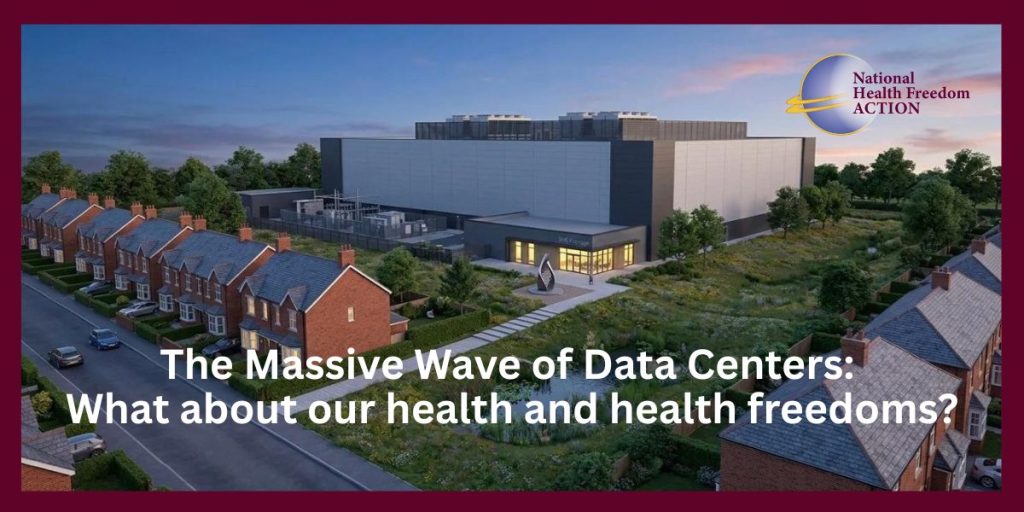
“Living in Hell,” “Like a Health Earthquake,” “We don’t see the dark of night anymore.” These are some of the descriptions of data centers and living near them, especially the gigantic data centers known as “hyperscale data centers,” which may contain “easily” as much as millions of square feet of space. Currently, there are somewhere around 4,000-5,000 data centers in the United States with at least 580 hyperscale facilities, with many more planned in all states, and more and more being built without community approval. That these data centers drain our water and explode energy usage is well-documented, but the impact on our health is less well understood and even less well provided to the public. Recently, there have been a few studies on the impacts of these centers on our health, and the conclusions do not bode well for those who are forced to live near the centers and even for those farther away. Even if the public gets health and environmental information about a center, what can the public do to be part of the decision-making process regarding these centers?
The public is not given full information
In Faribault, Minnesota, the City Council did an end run around environmental concerns like air quality and noise pollution when it decided that an Environmental Impact Statement (EIS) was not necessary for a new hyperscale data center, opting for the lesser environmental assessment worksheet. Minnesota law requires that an EIS be done when the project has the “potential for significant environmental effects.” The Minnesota Center for Environmental Advocacy (MCEA), a non-profit, sued the city of Faribault, and the appellate court decided that the city had failed to take a “hard look” at the environmental impacts and required the city to either order an EIS or postpone their decision so to include the missing information in their environmental study. An EIS would allow greater public engagement and would provide information that the public could use regarding the environmental impact of the center, what alternatives could be available, as well as possible ways to reduce the impact of the data center on the environment. In general, an EIS has not been required for data centers nationwide. The Faribault decision represents a welcome move toward greater transparency for the public as environmental concerns and health concerns are often either the same or overlap.
Data centers likely pose significant health risks
In a 2026 paper, Health Implications of the Rapid Rise of Data Centers in Virginia: An Exploratory Assessment, published in the journal Frontiers in Climate, the authors argue that data centers “may pose significant health risks” and these risks can include diseases that arise from air pollution, waterborne illnesses, mental and neurological health problems from noise pollution, impacts to well-being from degradation of the land, and consequences of increased energy costs especially to groups like the elderly or low-income individuals. Other researchers have estimated the public health financial burden of data centers in the United States to be $20 billion by 2028. Even just two of the health effects of data centers, noise pollution and air pollution, can have major negative health impacts that are not sufficiently regulated by cities and are not sufficiently disclosed by the data centers.
A data center can meet regulations for decibels, but the low-frequency noise pollution escapes regulation and is often the more irritating of the noises. The low frequency can create a “hum,” which is most clearly heard at night when other noises are diminished and people are trying to sleep. Some residents near a data center have reported hearing the hum from as far away as five miles.
Living by a data center in Illinois, neighbors say they hear fans that cool the computer equipment “all day and night.” One man who lives near the center, David Szala, stated that the noise was so intense that “you feel it in your bones.” Officials from the data center claim that this noise is unique to that center, and that efforts to reduce the noise are on the way. But claims of annoying and high levels of noise are not limited to the data center in Illinois but appear to be ubiquitous. Some others living near a center in Virginia, for example, report a debilitating ringing sound which is “intolerable.” That center states that it has complied with all ordinances regarding noise pollution, but because of the nature of the noise produced by these centers, the ordinances are outdated and do not protect the public.
Air pollution is another acute health concern for people around data centers
Data centers use large amounts of energy, especially natural gas and diesel, which “spew noxious chemicals into the air,” with both acute effects on the lungs, like asthma, and long-term effects such as chronic disease, reproductive problems, and premature death. According to a study from the University of California, Riverside, air pollution from data centers could push the annual public health burden from around $6 billion in 2023 to more than $20 billion in 2028. Another researcher estimates the cost to the economy because of the health and environmental impact of the centers to be $25 billion, and the fine particulate matter emitted by the centers to be a major cause. The air pollution from data centers could contribute to about 600,000 asthma symptom cases and 1,300 premature deaths by the same year.
The public should have full transparency and the ability to participate
The public is increasingly knowledgeable about data centers and groups are forming in an effort to defeat them in various cities. Legislation was introduced for moratoriums of data centers in 14 states by June 2026 but only one passed the legislature. A moratorium allows for greater study of the health impacts and will provide communities to educate themselves and to meet with and communicate with government officials before a center is built, instead of after. Many of these centers are being built in areas that are already environmentally stressed, where the people living in these areas are low-income and politically silent. These centers have a great impact on our health, and the public should have full knowledge of the hazards and participation in the process.