Appeals court delivers a setback to the plaintiff’s fluoride trial court victory
On May 21st, 2026, the Ninth Circuit Court of Appeals dealt a blow to the trial court’s earlier decision in which it ordered plaintiff Environmental Protection Agency (EPA) to adopt a rule protecting children from an “unreasonable risk” of harm to their brains posed by water fluoridation. That September 25, 2024 decision was a striking victory in the quest to put an end to water fluoridation. But, in its recent decision, the appeals court embraced one of the EPA’s arguments, namely the claim that the trial court judge, Edward Chen, had “commandeered” the trial and had violated the “party-presentation principle.” In its unpublished opinion, the appeals court cited a 2020 US Supreme Court case that illustrated the principle, that it is the parties that present the issues to the court and the court addresses the issues that the parties present. Claiming a need to act in accord with those principles, the appeals court vacated the trial court’s decision, nullifying it, and returned the case to the trial court judge with special instructions and limits. The special instructions are that the trial court is to reach an opinion on the matter based only on evidence and testimony gathered up to June 2020 when the first leg of the trial had been concluded and before the case was put “in abeyance.” That abeyance was a pause for an indeterminate amount of time so as to allow the court to receive into evidence an upcoming report on the state of the science being prepared and published by the National Toxicology Program (NTP), a federal agency that is part of US Health and Human Services. Ironically, the trial court had paused the case over the objection of plaintiffs and at the request of the EPA, claiming that more evidence, if brought into the case, would affirm its arguments.
It is also ironic that the secret reason for why the trial was held in abeyance for as long as it was (the pause lasted for several years!) was that the head of the Public Health Service, Admiral R. L. Levine, had secretly ordered that the NTP report not be released, even though it had been scheduled to be released back in May 2020. This apparent attempt to delay the resumption of the trial was, arguably, an obstruction of justice, but that sleazy instance of wrongdoing was not brought into the trial as a new legal issue.
While the appeals court does not allege that the trial court invented new issues to be tried, it does contend, just as the EPA did in its brief, that its expansion on fact-finding about the health impacts of water fluoridation on children’s health amounted to an “abuse of discretion” on the part of trial court Judge Chen, and thus was a serious procedural error in how the trial was conducted.
The strangeness of what the trial is to become now
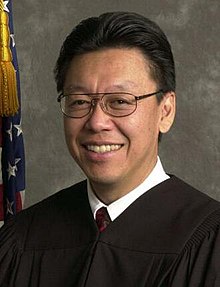
Judge Eward Chen
Trial court Judge Chen is now under orders from the appeals court to rule on the fluoride case using only facts and testimony available to him as of June, 2020 when the first leg of the trial ended. Some observers have wondered how the Judge can be expected to block out and exclude from his mind what the second leg of the trial, held finally in February, 2024, uncovered; the NTP report and other scientific papers which provided more evidence that fluoride was toxic for the developing brain. How can the Judge forget or obliterate the impressions he gathered as he probed the EPA’s testifiers for defects in logic and for consistency? How can his mind erase the impressions
made as to EPA’s honesty and integrity? We might even wonder how the Judge can be expected to forget the sternly worded order that he released on September 25, 2024, ordering the EPA to adopt a rule that curbs the practice of water fluoridation enough to protect the intelligence of children in America? Judge Chen is asked to do all of that, as he faces scrutiny and pressure from all sides, and the possibility, even likelihood that, if he rules again in favor of the plaintiffs based on evidence on hand as of June 2020, that the EPA will again appeal his ruling and seek to nullify his decision again. President Trump’s pick for EPA administrator, Lee Zeldin, is hostile to stricter, more protective regulations, and is more aligned with the American Chemistry Council, Big Oil and Big Gas than he is with reformers working for environmental protection and health. Health and health freedom advocate Robert F Kennedy Jr. tried to convince Zeldin to go along with the trial court’s order to begin protecting children’s brains from the unreasonable risk posed by fluoridation, but Zeldin held fast to his decision to have the EPA appeal the trial court’s order.
Was the appellate court’s finding against the trial court conduct correct, necessary or simply in error? Plaintiff’s attorney Michael Connett thinks it was wrong.

Attorney Michael Connett
Plaintiff’s attorney Michael Connett argues that the appeals court’s ruling was wrongfully taken. First of all, it is obvious that Judge Chen did not meander off into a different issue from what the trial was all about. Judge Chen remained fully focused on the core question of whether fluoride exposures need to be curbed by a new, protective EPA rule. The only allegation of abuse of discretion comes from the Judge putting the trial on pause in 2020 in order to allow soon-to-be-gathered more conclusive evidence. Was that step appropriately taken or was it an “abuse of discretion?” Attorney Michael Connett argues that Section 21 of the Toxic Substances Control Act of 1976 (TSCA) allows
a judge to regulate a chemical “de novo,” meaning that the court reviews available evidence without deferring to an agency’s position on an issue, and that a judge can consider a wide range of evidence. “This was a case where the trial judge heard argument and testimony at trial about important, new studies on the horizon which could shed important light on the very issues the judge was tasked with deciding,” he said. In commenting on the appeals court’s claim that the party presentation principle had been violated, Connett said that its claim was “a very expansive and unprecedented application of the party presentation principle,” and that, to date, “this principle has really only been applied to situations where judges raise new legal issues, not where judges use procedural mechanisms to resolve the issues presented.”
Plaintiffs are considering their options
Connett’s stark criticism raises the question of whether the plaintiffs will allow the case to come back to the trial court to be re-decided, or whether the plaintiffs will follow the more unusual path of appealing the case to the US Supreme Court or even to an en banc appeals court panel of 11 judges within the same Ninth Circuit Court. Neither of the latter two paths could be assured of happening even if chosen by the plaintiffs, as only about one out of every 100 cases that are appealed to the US Supreme Court are accepted for consideration. It is also uncommon for an appeals court decision to be reheard en banc (an enlarged appeals court of eleven appeals judges); the rehearing is usually only granted when the decision conflicts with either a US Supreme Court decision or a previous decision of the Ninth Circuit, or, the case involves a question of “exceptional importance.” Further, a majority of appeals court judges eligible to vote on the petition for rehearing en banc must approve the request. Stuart Cooper, Executive Director of Fluoride Action Network (FAN), one of the non-profit plaintiffs in the matter, says in a letter on FAN’s website “the case is still ongoing and our legal team is looking at all scenarios and all next steps available.”
Efforts afoot to weaken the EPA’s ability to regulate toxic chemicals and people’s ability to sue the EPA for failure to follow the science and properly regulate toxic chemicals
A group of federal lawmakers backed by big chemical, big polluter corporations, has been promoting legislation to weaken the Toxic Substances Control Act in what they tout as a needed “sweeping overhaul.” A key part of that overhaul is to eliminate the public’s right to file citizen petitions such as the one that FAN and other plaintiffs brought in this water fluoridation case. Just as big media is doing nothing to convey the momentous issues of the TSCA fluoride trial, it is doing little or nothing to alert the public about ongoing efforts to weaken the entire TSCA statute and make the EPA even less able to regulate toxins as is needed.
FAN remains convinced that stopping fluoridation will ultimately prevail
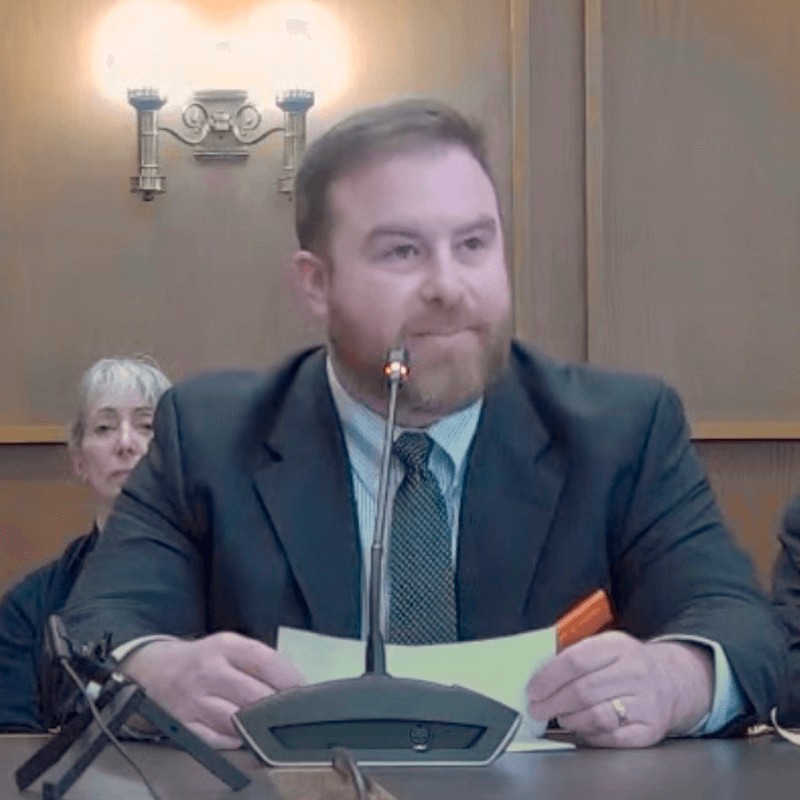
Stuart Cooper (FAN)