Farm Chemicals: From the White House to the State House to the Supreme Court
At a time when more and more Americans are waking up to the potential severe health impacts of pesticides and herbicides, some recent or upcoming legal developments include a Supreme Court hearing set for April 27 about personal injury liability immunity, as well as a tug-of-war between the White House and the Congress over glyphosate liability. At the same time, states are taking action limiting liability for these industrial farm products, in what appears to be a coordinated pro-industry trend.
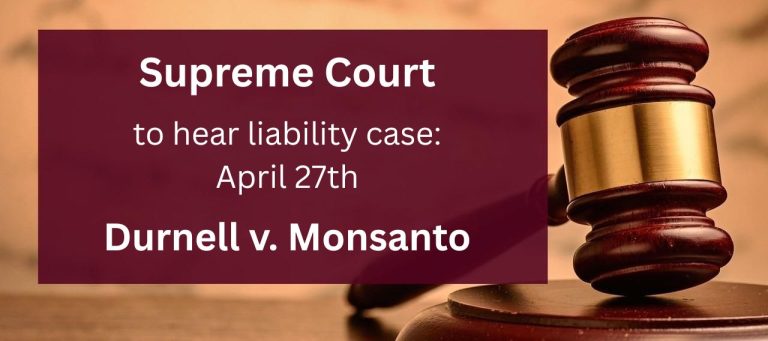
Durnell v. Monsanto: Supreme Court to hear liability case
On April 27 the US Supreme Court will hear arguments in Durnell v. Monsanto, focused on whether the Federal Insecticide, Fungicide, and Rodenticide Act (FIFRA) preempts state-level failure-to-warn lawsuits for people injured by agricultural chemicals. A key element of FIFRA is its role defining how warning labels are constituted and how they impact liability at the state level. This law says that a state cannot impose labeling requirements that are “different from or in addition to” federal regulated labels. So, the legal doctrine of preemption comes into play; this includes the idea that a given federal law usually trumps a state law on the same topic. Court watchers expect a decision in June 2026. As reported by the Financial Times, the opinion will affect thousands of cases alleging injury from these products. In the Durnell case now before the Supreme Court, Monsanto is appealing a 2025 ruling from the Missouri Court of Appeals allowing a failure-to-warn case to move forward towards jury trial.
Executive Order protects industry
The February 18, 2026, Executive Order, reflected the President’s position on the herbicide issue. Entitled, “PROMOTING THE NATIONAL DEFENSE BY ENSURING AN ADEQUATE SUPPLY OF ELEMENTAL PHOSPHORUS AND GLYPHOSATE-BASED HERBICIDES”. The directive says that elemental phosphorus is critical to the defense supply chain and is also needed in the production of the glyphosate-based herbicides used to secure the food supply.
The order held that both defense and protecting the food supply is essential for our national security. The order extends the Defense Production Act’s (DPA) liability immunity to the named products. The DPA limits liability when companies comply with government-directed production orders. It also requires producers to follow the order, reinforcing that they are acting under federal direction rather than purely private choice.
“No Immunity for Glyphosate Act”
In response to the Executive Order, on February 20 Representative Thomas Massie [KY] introduced the “No Immunity for Glyphosate Act” HR 7601 which would block federal protection for glyphosate makers and make it easier to sue them. The bill would ban any federal funding from being used to carry out the February 18 Executive Order. HR 7601 also creates a strong right to sue: anyone harmed by glyphosate or phosphorus exposure could file a lawsuit in federal court for medical costs, lost wages, pain and suffering, wrongful death damages and punitive damages (those designed to punish a defendant). It would ban firms from using a “the government made me do it” defense when they argue that compliance with federal laws, regulations, executive orders, and contracts. The legislation would also preserve all existing pending cases for liability while protecting future cases. Last, it says that federal law does not override state laws allowing even broader liability.
Many states acting to prevent liability
The battle over liability for pesticides and herbicides is also being waged at the state level, with legislation and new laws limiting liability in the news. In 2025 North Dakota passed HB1318 which bans failure-to-warn claims if labels comply with federal law under FIFRA and Georgia passed the similar SB144. About a dozen states have pending legislation limiting liability, including Kansas’ HB 2476, Iowa’s SF 2412, and bills in Missouri, Indiana, Tennessee, Arkansas, and Ohio. These state bills are strongly backed by the farm chemical industry.
As all these policy actions unfold, we need to work for consumer safety at the federal, state, and local level. The Pesticide Action Network provides guidance on how people can get involved now. The April 27 Supreme Court arguments can be listened to here.