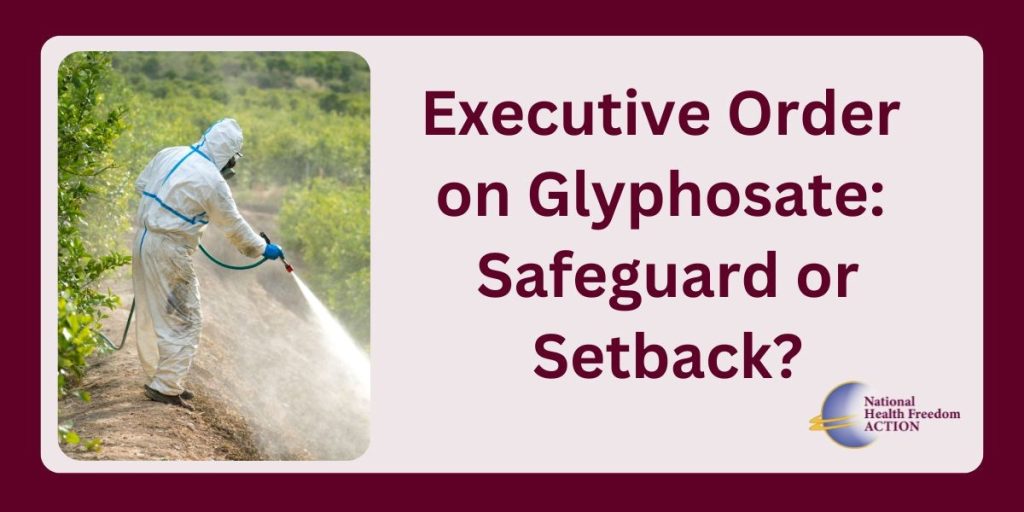
President Trump’s February 18thexecutive order seeks to protect the domestic production of glyphosate, the active ingredient in Roundup and dozens of other weedkillers. The executive order has stirred up some sharp protest. The Make America Healthy Again (MAHA) movement activists cite glyphosate’s devastating impacts on health and the environment. HHS Secretary Robert F Kennedy Jr’s longstanding opposition to glyphosate includes his previous promises to stop its use and his successful lawsuit against Monsanto for the cancer suffered by a groundskeeper due to his exposure to glyphosate in Roundup. The president’s executive order comes not long after opponents of “immunity shields” for glyphosate companies won victories in Congress.
Glyphosate has a central role in conventional agriculture as it is both widely used on GMO crops that are modified to be resistant to it and as a desiccant that causes crops such as wheat, oats and canola to become dried and ready for harvest before the first snowfall can occur and make the crop harvest impossible. The order declared that any interference with the production of phosphorus for the military or for glyphosate-based herbicides “gravely endangers national security and defense, which includes food-supply security.” The order protects the domestic production of phosphorus, which is not only needed for military purposes, but which is also an ingredient needed for the production of glyphosate.
Big agriculture’s vulnerability due to dependence on glyphosate
The order was motivated partly by the vulnerability of the domestic supply of phosphorous because it is currently being produced domestically at only one facility. But another supply chain vulnerability comes from lawsuit damages being assessed against Bayer, the German company that acquired Monsanto and that has been sued by numerous victims of glyphosate. Victims of glyphosate have been justly awarded billions of dollars because of the cancers and other disabilities inflicted on them by the weedkiller.
MAHA angry over protection of glyphosate especially immunity
The executive order was understandably met with concern and criticism on the part of many in President Trump’s MAHA base, especially as the order contains a provision providing immunity to manufacturers. Anger over immunity has led to a new bill, the “No Immunity For Glyphosate Act.” Reform-oriented MAHA supporters have been looking for a more consistent path towards reform in the second term of President Donald Trump. His appointment of Robert F Kennedy Jr as Secretary of Health and Human Services has opened a path for reform within HHS and at key agencies within HHS such as the FDA and NIH. But President Trump’s appointment of Lee Zeldin as EPA Administrator triggered some dismay and consternation among the MAHA reform base. Part of that is because Zeldin’s EPA has appealed the trial court’s judgment against the EPA in the nationally prominent water fluoridation case; the EPA has also adopted weaker stances on environmental and health protection cozying up to chemical polluters rather than making air and water regulations tougher.
Monsanto’s lies and fraudulent science hid the devastating harm inflicted by glyphosate
American agriculture has developed a huge dependence on Monsanto seeds, weedkillers, and other products in order to function. Monsanto schemed to have it that way. Throughout mid-western states GMO corn and soy mono-crops dominate the landscape. Those crops provide feed for hogs, poultry and other animals that are mostly raised in the unhealthy confinement of factory farms. The book Toxic Legacy by Stephanie Seneff, PhD, (Chelsea Green, 2021) spells out in convincing detail the evidence of harm to farming regions and to the many consumers who eat conventionally raised food, both plant and animal. Organic, regenerative agriculture shows the way to grow food in a way that is healthier to all, the grower as well as the consumer. This particular executive order raises the question of whether it sends the United States irrevocably down a path of perpetual dependence on a toxic model of agriculture? Or is it still possible to move in a better direction, away from toxic agriculture? What does the HHS reformer Kennedy think of the new executive order? Will he still push to move agriculture in the right direction? We now have the answer.
Kennedy has issued his own statement on the executive order: a more visionary message
On Monday, February 23rd, Kennedy released a one-page statement both voicing support of the executive order and its rationale but also stating that “we are changing course.” Kennedy reveals that he will be working to free farmers from the dominance of Monsanto agriculture. Seeking to avoid pointing the finger of blame at his boss, Kennedy says “President Trump did not build our current system, he inherited it.” Federal policy makers are responsible, he says, and their “deliberate choices locked farmers into chemical dependence and prioritized short-term output over long-term soil vitality and human health.” Kennedy reveals that he is “working with [USDA] Secretary [Brooke] Rollins and EPA Administrator Lee Zeldin to expedite a better future where a thriving agriculture system is less dependent on harmful chemicals … through a practical transition.” And, sounding like the founder of Children’s Health Defense that he is, Kennedy declares that “our children deserve a food system that protects and strengthens health.”
Kennedy’s message of hope to MAHA
Kennedy’s message on the president’s executive order is to offer assurance that the spirit of reform has not been lost and that reform is in the works for agriculture too. A transition away from toxic agriculture is still ahead, Kennedy declares. The recent executive order is a recognition of current, near-term food-chain vulnerabilities and a current dependence, however unfortunate, on glyphosate for food production. But Kennedy assures a major transition away from toxic food production is needed and he will be a major force in making sure that it happens.
Some dangling questions and criticisms
Certainly, it would have been more productive if President Trump, RFK, Jr and other officials would have done a press conference at the time of the signing of the executive order, to explain exactly why continuation of glyphosate was necessary and exactly what is also being done to change agricultural dependence on glyphosate. The phrase in the order equating glyphosate use with “the availability of healthy, affordable food options within reach for American families” does not suggest that a transition to a safer, regenerative agriculture is being contemplated. Health reformers could have been reassured if specific orders regarding this toxic glyphosate-based herbicides, including a timeline for the discontinuation of its use, the banning of its use on lawns and as a desiccant for crops, and a well-formulated plan to wean agriculture off of its use.
Other issues remain. Is legal immunity of Bayer from lawsuits really needed? Is legal immunity reasonable and necessary as otherwise these products would need to be purchased from China and other countries? Could there have been provisions for just a short-term immunity for particular uses? And, if legal immunity from lawsuits is provided under law, what would happen to the many injured victims of these weedkiller products, both past and future?