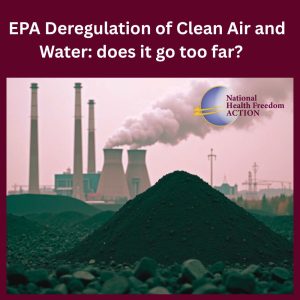
Last week we looked at current plans to weaken the Environmental Protection Agency’s (EPA’s) ability to regulate harmful chemicals and to remove the ability of citizens to sue for protection from hazardous chemicals when the EPA refuses to regulate. But what does EPA have in mind for our clean air and water? In 2025 EPA Administrator Lee Zeldin announced massive deregulation to “drive down cost of living for American families, unleash American energy, bring auto jobs back to the U.S. and more.” Since this announcement, EPA has been busy setting forth this agenda, including a recent deregulation of the 2009 endangerment finding regarding greenhouse gases. Expect more announcements by EPA regarding specifics of these deregulations in 2026.
Congress passed the Clean Air Act in 1970 and the Clean Water Act beginning in 1948 and certainly some regulations under these acts may no longer make sense. But other deregulations by EPA of our clean air and water seems to be EPA once again acting hand-in-hand with industry at the expense of the environment and public health.
EPA Weakens the Standards on Soot
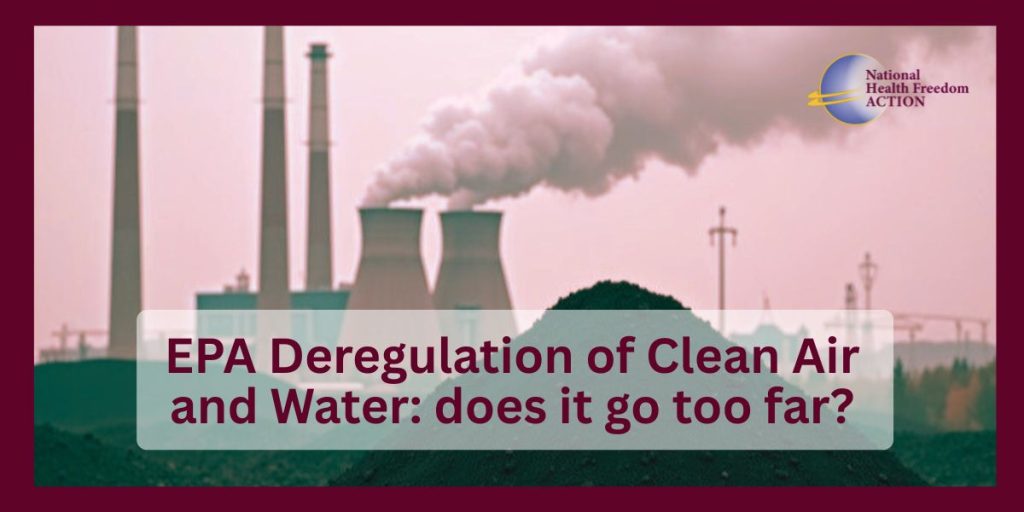
One example is deregulation of the Particulate Matter National Ambient Air Quality Standards. Fine particulate pollution, or soot, measured at PM2.5 (particulate matter 2.5 micrometers and smaller), comes from a variety of areas including coal fired power plants and can travel from the lungs into the bloodstream. The Biden EPA after reviewing scientific research showing that existing standards regulating soot were not sufficient, tightened the particulate matter standards. EPA estimated these tighter regulations would include “up to 4,500 avoided premature deaths, 800,000 avoided cases of asthma symptoms, and 290,000 avoided lost workdays” annually by 2032. The current EPA under Administrator Lee Zeldin says that the US has low levels of soot and that the tighter regulations are not needed and simply slow down the economy.
The Regional Haze Program Going Up in Smoke?
The Regional Haze Program requires states to work with EPA, the National Park Service, U.S. Fish and Wildlife Service, the U.S. Forest Service, and others to reduce the pollution that causes hazy scenic views in 156 National Parks. The first plans were rolled out in 2007. Lee Zeldin stated that the US “has made significant gains in improving visibility in national parks and other wildlife areas’ and that the program was not “intended to be the justification for shutting down every power plant and industrial sector in the country.” This deregulation, which will restructure the program, appears to be a concession to the polluters at the cost of protecting the lungs of the people.
Coal Ash Program Expediting State Permits and Allowing Industry More Time to Comply
When coal is burned, coal combustion pollutants including arsenic, lead and mercury are left behind in the ash which is typically stored under federal regulations. Of course, lax coal ash rules could mean more coal ash into the air but also can allow companies to avoid responsibility for cleaning up toxic coal ash pits. Coal power plants put the coal ash into pits that can leach into wells and groundwater. The EPA is now looking to put regulation for this waste “more fully into state hands,” which environmental groups believe will lead to weaker standards. EPA announced a rule on February 6, 2026, which allows industry, depending on the action, up to three additional years to meet deadlines for monitoring and disposing of coal combustion pollutants properly.
Some of EPA’s Actions not Consistent with MAHA
These three examples of EPA deregulation show the EPA ignoring health and the environment for the economy. HHS Secretary Robert F. Kennedy Jr.’s MAHA (Make America Healthy Again) movement is at odds with some of EPA’s deregulation. The environment impacts public health, and public health is not what it used to be; it has not gone in the right direction. If our air and water are polluted, this will impact the health of the environment and of course the people living in this environment. One state cannot have lax pollution enforcement without impacting not only those in the state but those in other states. Reforms should still protect the people.
EPA a Mixed Bag?
Arguably some of EPA’s actions, like deregulating the push toward electric vehicles for all, which is part of the recent deregulation of the endangerment finding, have some positive features. Some might think that electric vehicles have their own pollution including lithium and other metals for batteries, dangerous fire risk, and possible connection to 15-minute cities and are therefore not an environmentally sound mandate. Industrial polluters also have a history of cutting corners and attempting to decrease their investment in cleaning up the toxins they leave in the environment. EPA must not be derelict in its duty to regulate these polluters. Contact your members of Congress to let them know that our health is connected to the health of the environment and that EPA must maintain our clean air and water.