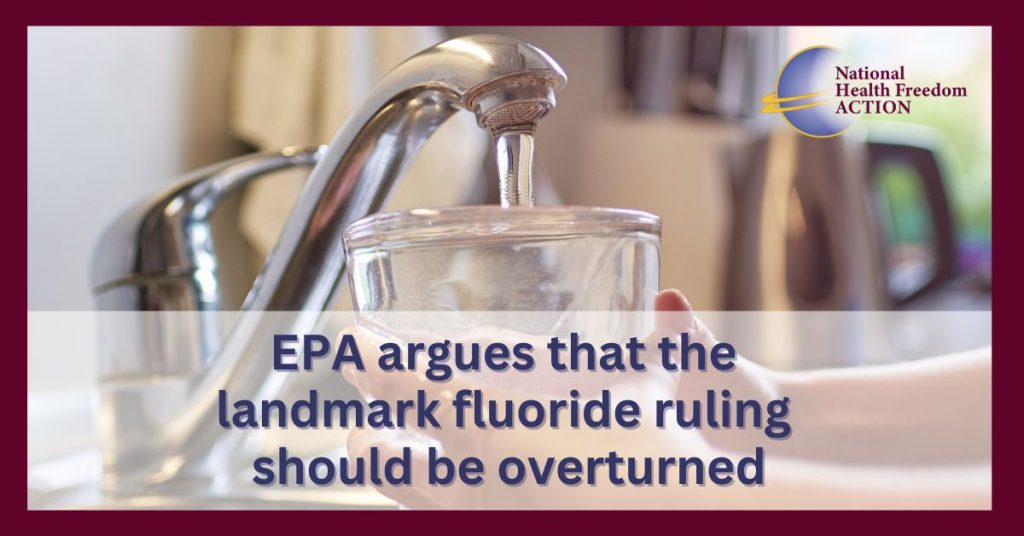
Even while not contesting the trial court’s scientific conclusion of risk of harm to children’s brains, the EPA argues that the landmark fluoride ruling should be overturned
The Environmental Protection Agency (EPA) argued their case this week in their appeal of the landmark fluoride case where the trial court had ruled that fluoride added to drinking water posed an “unreasonable risk” of harm to the brains of children and had ordered EPA to make a new rule protecting children from this neurotoxin. EPA did not appeal on the grounds that the science was bad, but rather on other grounds, including an objection to the way that the trial court ran the case. On March 3, 2026, a three-judge panel of the 9th Circuit Court of Appeals heard a hard-fought battle between attorney Robert N Stander, Deputy Assistant Attorney General representing the EPA in its effort to overturn the trial court’s decision on water fluoridation, and attorney Michael Connett, JD, representing the non-profits Food and Water Watch, Fluoride Action Network and others.
The lower court ruling in September 2024 seemed to spell a death knell for water fluoridation in America and, since then, there has been a cascade of local governments repealing this practice. Two states, Utah and Florida, have enacted laws totally banning water fluoridation. If the appeals court affirms the trial court, the cascading effects of stopping water fluoridation would surely accelerate, even without waiting for the EPA to write a protective rule. If the appeals court rules in favor of the EPA’s appeal, that may somewhat dampen the movement to end water fluoridation in the US.
The three appeals court judges
The judges on the appeals court panel are Sidney R Thomas, Ronald M Gould and Brian Morris. Thomas and Gould were both appointed to the 9th Circuit Court of Appeals more than two decades ago by President Bill Clinton. Brian Morris was appointed to a Montana court position by President Obama in 2013 and was later elected by the state’s voters to the Montana Supreme Court. All of these judges are very experienced in matters of law and have decided many court cases over their long careers. In their conduct of the hearing, they all appeared to be focused on the legal arguments made by both sides and showed no bias during the historically important case before them.
Attorney Robert Stander represented the EPA in its appeal
Department of Justice attorney Robert Stander led off with three EPA arguments to vacate the trial court’s judgment. Stander’s work history includes clerking for Supreme Court Justice Clarence Thomas and then working for approximately 10 years for the law firm Jones Day, a firm that represented Bayer in its acquisition of Monsanto. Stander has also recently signed an amicus brief (along with others at the DOJ) asking the US Supreme Court to support Bayer in a case that could leave victims of the herbicide Roundup without any remedy.
These three EPA arguments are:
The trial court allowed an “ever-evolving” series of scientific studies regarding fluoridation’s harmful effects instead of just stopping the case after examining the evidence set forth by the plaintiffs in their petition.
The judge “commandeered” the case, allowing a lengthy pause at the end of phase one of the trial when (supposedly) both parties objected and wanted a final ruling.
The plaintiffs lacked “standing,” e., a demonstration that they would be affected by the outcome of the case.
EPA criticized the “ever-evolving scientific evidence” being brought into the trial court case
Attorney Stander criticized the judge for pausing the trial in 2020 in order to wait for a much-touted National Toxicology Program (NTP) monograph that would provide a robust state-of-the-science overview on fluoridation. The NTP is a US Health and Human Services program that provides science on toxic environmental substances that agencies like the EPA can use. The trial court record shows that the EPA very much wanted the court to bring in more evidence, always arguing, of course, that the existing science was too skimpy and too equivocal to allow them to determine clear risk levels and hence to determine a risk of harm. Perhaps Judge Chen decided to call EPA’s bluff and to give them time to use the NTP report, so it could not complain about the incompleteness of the science. Perhaps he wanted to fend off a possible EPA complaint that the judge was biased against allowing a full exploration of the state of the science.
So, the judge paused the trial until the NTP could be obtained. Even at a hearing in 2023 EPA wanted to delay resumption of the trial by another six months, but the judge firmly decided to resume the trial as soon as possible. It ended up resuming in January 2024, after the judge had plowed through the EPA’s obstacles and obfuscation.
Plaintiff’s attorney Michael Connett, in his rebuttal argument, said that a trial court judge has great discretion in how to conduct a trial and he was within his rights to bring in “state of the science” evidence so as to make a correct decision in order that justice be served in America.
No scientific evidence should be considered after the initial petition, EPA claimed
This is another argument that EPA failed to make to the trial court. In examination of many studies and evolving evidence, EPA brought up evidence from studies that it claimed their stance – the stance of paralyzing uncertainty and contradictory results, forcing to remain in inaction. If the judge ended up “buying” EPA’s views on the science, it would have praised the trial court judge’s decisions on what science to allow; but the judge’s verdict did not go their way and so they had to come up with arguments that the judge deviated from what was called for in the TSCA statute.
But attorney Michael Connett researched the Toxic Substances Control Act (TSCA) and found that, upon examination, the legislative intent behind TSCA was to explore the issue in a “de novo” (new) manner and determine fully what the facts are regarding the toxin in question.
EPA argued also that the plaintiffs did not have standing
It seems far-fetched to the casual observer that, in a country where 72.3% of the people receive drinking water from public water supplies with added fluoride that EPA would argue plaintiffs had no standing to sue EPA for its inaction. The EPA even argued that one of the plaintiffs, a pregnant woman living in (fluoridated) Leawood, Kansas did not have standing. But EPA dredged up evidence that the river where Leawood gets its city water already has some fluoride contamination in it – between 0.24 and .40 ppm. EPA claimed that since the plaintiff already had some fluoride exposure that city water adding a lot more fluoride to the water did not give the plaintiff standing.
Plaintiff’s attorneyMichael Connett argued that this was a new factual claim, one never brought up by EPA in the trial court and hence was unable to be vetted on cross-examination. Furthermore, the EPA, by not wanting to curb municipal water fluoridation, simply allows the injury by fluoride to get worse. The injury caused by water fluoridation does not have to be the entire cause of fluoride injury. So, the plaintiff does have standing, Connett argued.
Conclusion: The judges on the appeals panel seem to want to find a legally sound opinion on the very important ruling. An opinion is likely to be months down the line (late summer?), according to legal observers. The arguments will revolve around the trial court case itself and the arguments at the hearing today. But the larger picture about fluoridation is that it was and is supported by special interests who have some wrong doing to cover up. The toxic product being used is a scandal in itself. The many harms inflicted on human health is also a scandal: harm to bones, connective tissue, teeth (dental fluorosis), kidneys and intestines as well as the human brain. And, finally, it is an assault on our basic freedoms, and a violation of our health freedom. The final victory, bringing water fluoridation to an end, seemed to be so close at hand in September 2024. But because of the case on appeal, the battle is not finished. We will find out how that went when the appeals court judges announce their decision later this year.