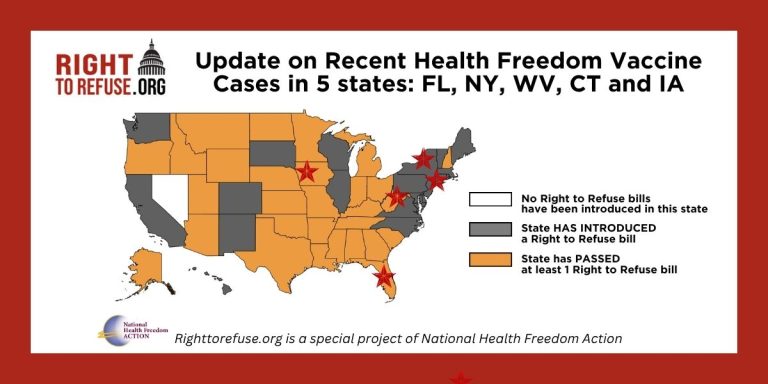
The Covid-19 pandemic years brought health freedom issues related to medical interventions to everyone’s attention in ways most had not considered before. Mandates were issued, and exemptions and protections for the right to make personal health decisions were taken away across the nation. School vaccine requirements became a hot point of contention for many. While some states passed laws that added exemptions and protected the rights of students, parents, and workers to make their own health decisions, others removed these freedoms. Many of those laws and rules are now in the courts and are being litigated from all sides.
Vaccine mandates are a freedom issue
Requirements for student vaccinations have been a contentious issue in the USA for well over 70 years. National Health Freedom Action opposes mandated medical interventions including mandatory K-12 vaccinations, based on our constitutional freedoms. Our nation was founded upon the premise of a moral and well-informed populace. Parents deserve to be trusted enough to make this decision. In that light, we applaud state efforts to end school vaccine mandates. It is worth noting that most European countries – 16 out of 28 – do not have K-12 vaccination requirements, and there have been no notable problems with these voluntary vaccine policies. Sweden, for example, has voluntary immunization, and over 90% of kids get the recommended vaccines.
Florida’s move to eliminate vaccine mandates facing important December hearing
In September 2025, Florida Surgeon General Joseph Ladapo announced that the state intended to end all of its vaccine requirements, including those for K-12 students. Four vaccines required for school and daycare entry may be changed by the Florida Department of Health (DOH) through rulemaking: Hepatitis B, varicella (chickenpox), Hib, and Pneumococcal conjugate.
On October 8, 2026, the DOH held a public hearing to consider the proposal that would update Florida immunizations and exemptions guidelines and requirements to opt out of the Florida SHOTS program. The public hearing was an opportunity for the DOH to hear public comments about the proposed changes and was not a final adoption of the rule.
Despite the 2025 announcement by Surgeon General Ladapo and Gov. Ron DeSantis that the state would move to end all vaccine requirements, the remaining vaccine requirements need legislation to do so. Even though there was a push from the Governor and Surgeon General, no legislator filed a bill in 2026 that would end all vaccine requirements.
A “Medical Freedom” bill (SB 1756) in 2026 would have expanded vaccine exemptions to include personal conscience and mandated doctors to provide an alternate vaccine schedule passed the state Senate but failed to pass the state House.A House version of the bill was never given a public hearing and died on the calendar.
New York’s “Amish Challenge” to Religious Exemption Repeal
New York repealed its religious exemption for school vaccine mandates in 2019, thereby leaving only medical exemptions, which are always difficult to get, for people to opt out of vaccines for their children. The Amish community adhered to its religious liberty and conscience and refused to vaccinate for religious reasons. Amish children were in Amish schools on Amish property. New York fined three Amish schools in an amount totaling $118,000.
The families sued, arguing the mandate fundamentally disrupts their insular, faith-based way of life. The Amish Petition (Miller v. McDonald) went before the U.S. Court of Appeals for the Second Circuit, which agreed with New York and ruled against the Amish families. The case has now been appealed to the Supreme Court, and a coalition of 17 states and groups including the Association of American Physicians and Surgeons filed amicus briefs, formally urging the U.S. Supreme Court to restore religious exemptions. The Miller case is the most significant case to watch regarding religious freedom in the area of vaccine mandates.
West Virginia Battle Over Religious Exemptions
West Virginia is historically one of the few states that completely bans non-medical exemptions for school requirements. Just after taking office in 2025, Gov. Patrick Morrisey issued an executive order to allow religious exemptions to the vaccine rule based on religious freedom. During the 2025 legislative session, legislators took up a bill to allow religious exemptions to make Gov. Morrisey’s order West Virginia law. The bill was vigorously debated but did not pass. Gov. Morrisey has maintained his Executive Order is in effect.
The West Virginia Board of Education issued a counter-directive instructing county school boards not to accept religious exemptions, defying the governor’s executive order. State education officials have indicated that they will enforce strict compliance with existing statutory vaccine laws until the State Supreme Court issues a final ruling on the matter.
In October 2026, the West Virginia Supreme Court announced it had consolidated two cases that would be heard for oral arguments and decision, citing Rule 20, reserved for matters of significant public importance. The consolidated case has not yet appeared on the docket but will likely be heard in the Spring 2027 term.
Connecticut’s Religious Freedom Restoration Act Protections Struck Down
Like New York, Connecticut eliminated non-medical vaccine exemptions for students in 2021. In September 2026, a Connecticut Superior Court judge dismissed a long-running, four-year lawsuit (Spillane v. Lamont), which challenged the elimination of these exemptions. Parents had argued that the lack of religious exemption violated Connecticut’s Religious Freedom and Restoration Act (RFRA). During the appeal, the state legislature passed a law clarifying that RFRA does not apply to school immunizations. State legislators opposed to the elimination of religious and other non-medical exemptions asserted that the legislature’s new law changed the outcome of the lawsuit in the middle of the case.
Iowa Private University Vaccine Requirement Upheld – Sincere Religious Belief Doubted
In late October 2026, the Iowa Supreme Court upheld the dismissal of a religious discrimination lawsuit (Perry v. Dordt University) brought by a former nursing student against Dordt University. The student sued after being denied a religious accommodation for a clinical rotation vaccine requirement. The high court’s decision questioned the plaintiff’s bona fide religious belief claims and motivations behind the lawsuit, stating that the plaintiff didn’t object to vaccines based on his sincere religious beliefs. The court stated that the parents of the student were the ones who really objected, not the student himself, though he had financial incentives to go along with his parents’ objections.
NHFA will continue to monitor important news about these sorts of important health freedom issues!